
RASTAHASH / REPAIR REPORT
Satoshi-01 is back from the repair shop.
A new board, a long wait, and some reggae to keep me going. My experience with TINYchiphub’s repair service — and why I’m still keeping an eye on Satoshi-02.
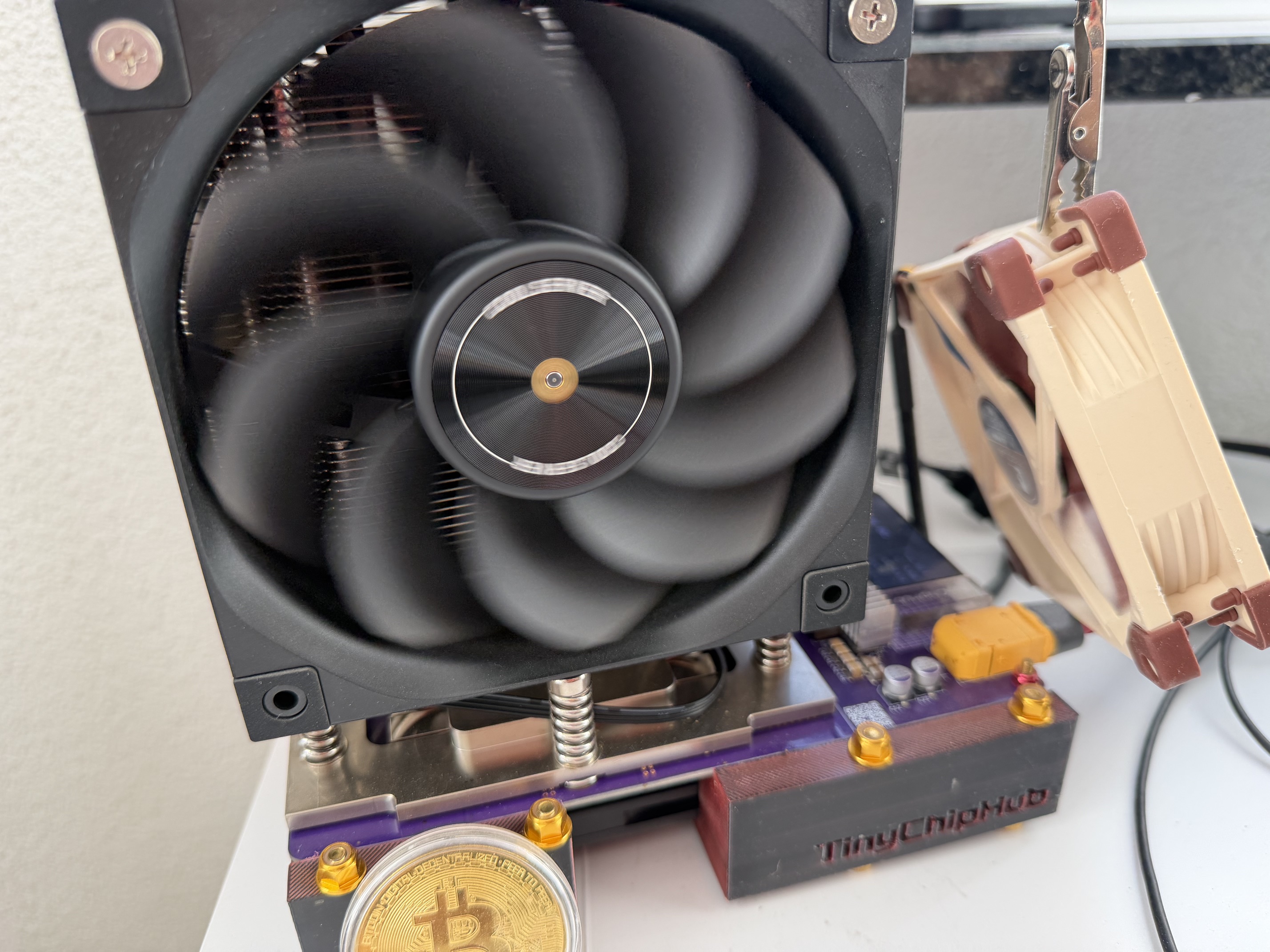
Transparency: This is my personal experience with my private home/solo mining setup, not paid advertising. During an earlier support case, TINYchiphub provided an additional miner and a Premium cooling unit as part of a solution we worked out together. I paid for the board replacement and shipping described here.
Irie, mining family! If you read my previous Zyber 8G review, you’ll remember how things started: temperature issues, stability problems, and eventually a very generous response from TINYchiphub. They sent me a brand-new miner along with a Premium cooling unit for my original device. I still appreciate that. Afterward, both miners were running at around 10 TH/s with impressive temperatures. The mood was good, and the fans were humming a steady bass line.
Then Satoshi-01, my original Zyber 8G, went completely silent.
On August 3, 2026, I reported the failure to TINYchiphub. It wouldn’t boot, I couldn’t reach it over the network, and it showed no signs of life. The eventual diagnosis confirmed a fault on the board.
That’s disappointing when a miner is only about six months old. I hadn’t been pushing it with extreme overclocking, either. My previous review documented a modest increase from the factory’s 600 MHz to 625 MHz, with the core voltage unchanged at 1.15 V. That alone doesn’t establish what caused the later failure.
On August 4, I packed Satoshi-01 for its trip: carefully protected, the board’s QR code photographed, and my order number clearly attached around the miner. DHL shipping to China cost me approximately €25, which I actually thought was pretty reasonable for the journey. On August 5, support confirmed that they had received the tracking link and could follow the shipment.
Unfortunately, the miner’s first extended stop turned out to be the post office.
According to the tracking information, the package had been waiting for pickup in Hong Kong since August 13, after delivery to the address supplied by TINYchiphub had been unsuccessful. I notified support on August 14, then followed up on August 19.
On August 26, TINYchiphub finally confirmed that the person responsible had collected the package, the miner had reached them, and inspection had begun. They also apologized for the delayed response.
Friendly communication, yes. But the process had already required considerably more patience than I’d hoped.
On August 28, I asked how the diagnosis was going. I know, I know — patience is a virtue. I’m working on it. 😄
The preliminary assessment arrived on August 29: damage somewhere on the circuit board was affecting signal communication, and locating the specific faulty component would take more time.
After another follow-up on September 1, the miner was still in the diagnostic phase. Support explained that the problem was more difficult to pinpoint than initially expected and that they were checking the board step by step.
On September 3, I gently knocked on the digital workshop door again. Somewhere along the way, TINYchiphub also offered me a discount on the new 12G, independently of the repair status of my 8G. A nice gesture, although my priority was getting the miner I already owned back on its feet.
After another inquiry on September 18, I finally received a more definite assessment.
TINYchiphub openly acknowledged that work on optimizing the Naja Duo had delayed attention to my board. According to support, they had initially suspected a faulty ASIC and replaced the chips one by one with known-good units. Even after replacing all the chips, the device still wasn’t operating normally.
Further inspection revealed a short involving one of the PCB traces.
Support described that type of repair as difficult and time-consuming. Their proposed solution was a replacement board with a brand-new PCB for $150.
Oof. Time to turn the reggae down for a minute and let that sink in.
An additional repair bill on a relatively young miner isn’t an easy thing to celebrate. I also told support that, based on my experience, I was starting to question the boards’ durability — especially since Satoshi-02 had recently begun showing problems, too.
Whether manufacturing, PCB construction, or something entirely different is involved, I can’t say. My experience alone certainly doesn’t establish a problem across the entire product line.
I eventually accepted the offer and paid $150 plus return shipping. On October 8, 2026, Satoshi-01 arrived back repaired. From shipment to return, the whole journey had taken just over nine weeks.
That’s a pretty long tour for a little desktop miner.
My verdict on the repair service is mixed. TINYchiphub remained friendly and ultimately offered a concrete solution. Package collection, turnaround time, and regular progress updates could all use improvement. Their admission that another product had delayed work on my board was honest, but as the customer waiting for a repair, I would have appreciated a more dependable timeline.
Their earlier generosity absolutely belongs in this story, too. Providing an additional miner and improved cooling was a substantial gesture, and I haven’t forgotten it.
At the same time, after two complete failures in my Zyber experience, I’m not satisfied with the reliability I’ve seen so far. Helpful support matters. Hardware that keeps working matters just as much.
Which brings us to Satoshi-02, who has recently started missing a few beats of its own.
Both miners currently run v2.11.8-Zyber with identical settings, which is also listed as the latest release in the official Zyber firmware repository. That establishes the firmware baseline for my ongoing observations. Official firmware release ↗
With Satoshi-02, I sometimes see only around 7–8 TH/s at the pool. ASICs 7 and 8 also appear to struggle intermittently, then seem to recover after the miner has been running for a few days.
From what I can see, it looks as though the software may be adjusting something in the background. That’s an observation, though, not a confirmed diagnosis.
Bassin makes the gap visible
Both Zyber 8G miners run v2.11.8-Zyber with identical settings. In this Bassin screenshot, Satoshi-02 trails Satoshi-01 across all three time windows compared below. Their one-day estimates are 9.16 TH/s and 7.93 TH/s — a gap of 1.23 TH/s, or approximately 13.4%, relative to Satoshi-01. These figures come from this screenshot; they are not a controlled long-term measurement.
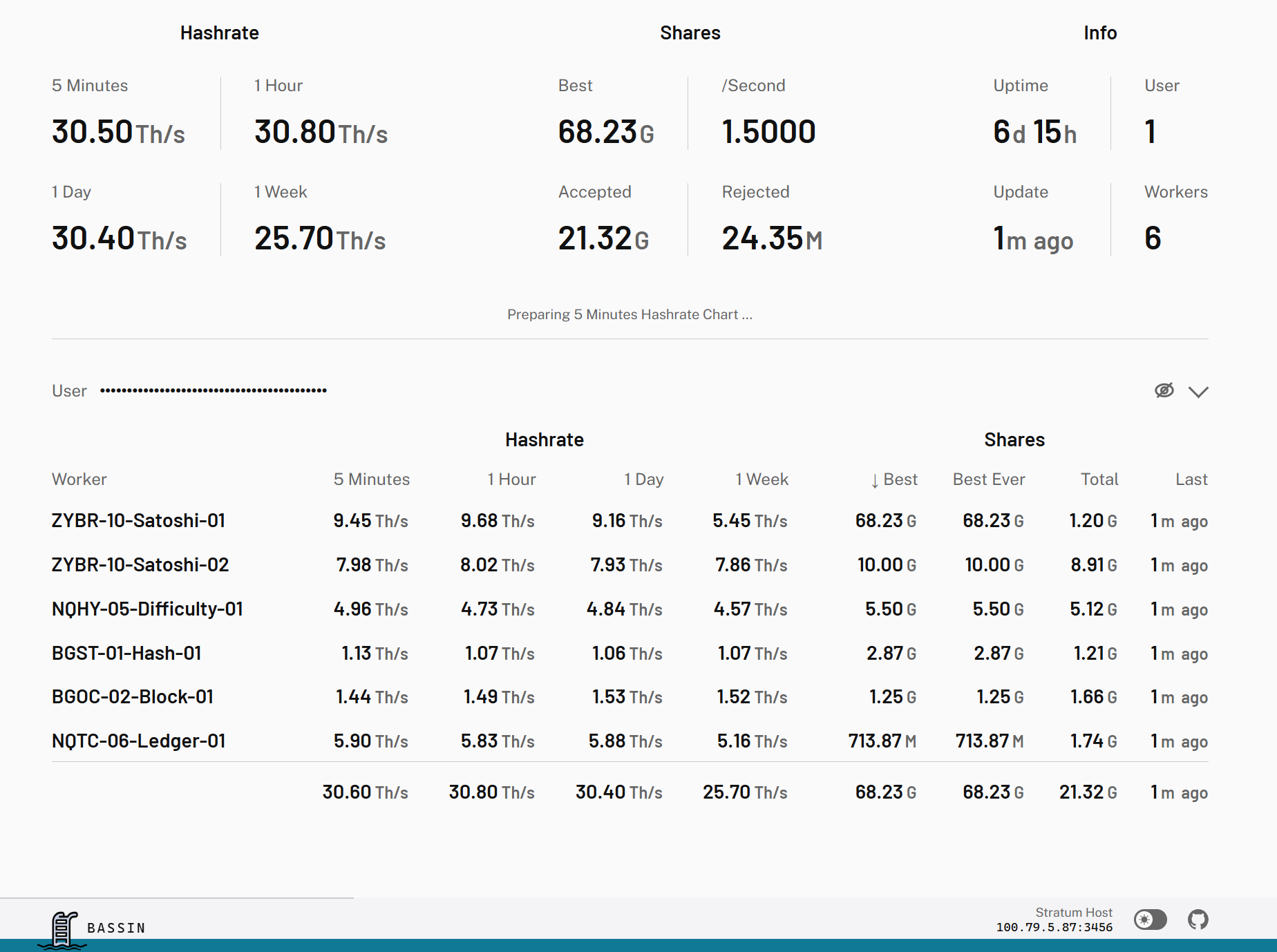
| Time window | Satoshi-01 | Satoshi-02 | Difference vs. Satoshi-01 |
|---|---|---|---|
| 5 minutes | 9.45 TH/s | 7.98 TH/s | −1.47 TH/s · −15.6% |
| 1 hour | 9.68 TH/s | 8.02 TH/s | −1.66 TH/s · −17.1% |
| 1 day | 9.16 TH/s | 7.93 TH/s | −1.23 TH/s · −13.4% |
The screenshot also includes one-week estimates. Without matching uptime histories, I am not using those for a direct performance comparison.
What the hashrate registers show
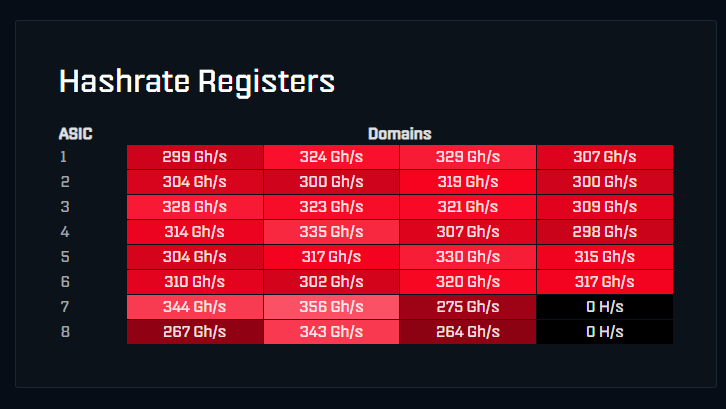
The register screenshot shows 0 H/s in the fourth domain of both ASIC 7 and ASIC 8. The other three domains in each of those rows are still producing hashrate at that moment. This screenshot therefore does not show both ASICs completely offline.
Right after powering on, I sometimes observe something worse: rows 7 and 8 can show no hashrate at all. That is my additional observation during startup; this screenshot captures a different operating state. Whether communication, initialization, reporting, or hardware is responsible remains unresolved.
TINYchiphub’s response to my description was that those pool readings aren’t necessarily unusual. I’m still not entirely reassured.
For me, what reaches the pool over time matters most. Pool hashrate estimates also fluctuate because shares arrive randomly, so a single low reading doesn’t prove a hardware fault. That’s why I’m continuing to watch the longer-term results before drawing conclusions. Background on pool hashrate estimates and fluctuations ↗
So, Satoshi-01 is back, and Satoshi-02 remains under observation.
I still really like the Zyber 8G’s appearance and Premium cooling setup. My experience with long-term reliability hasn’t given me the same confidence yet.
I’ve also found a small clue in the Zyber 8G code. What it actually means remains an open question. More on that in about two weeks, in the next update:
“Aren’t We All a Little Paranoid?” 😄
One love, mining family. Here’s hoping the boards hold up and all eight chips find the same rhythm. 🇯🇲⛏️