
RASTAHASH / COLUMN
Aren’t we all a little paranoid?
Satoshi-01 and the top-secret Department for Pleb Suppression

The all-clear first: our targeted examination of Bitcoin Core found no sign of a built-in disadvantage for small lottery miners. My tinfoil hat received a precautionary firmware update anyway. You never know.
It started with a perfectly innocent thought. Around May, Satoshi-01 landed a best-difficulty result above 450 G. You do not simply look at a number like that. You contemplate it. For a moment, you wonder whether your after-work beer might qualify as a business expense. Then you wait for the encore.
Unfortunately, randomness has no customer service department.
Eventually, a little voice piped up: wasn’t it better before? A different Core version, prettier results, friendlier cosmic vibrations? Had someone secretly fiddled with the lottery button?
And so the RastaHash Special Commission for Suspiciously Unsuspicious Software Updates opened for business.
The suspicion came with its own tinfoil hat
In my imagination, it went something like this: behind an unremarkable office door sat the imaginary Department for Pleb Suppression and Very Small Miner Affairs. A telephone rang. “Boss, that Rastafari with his living-room miners still dreams of finding a block!” Someone pressed a red button, and Satoshi-01 supposedly started receiving nothing but hashes from the bargain bin.
The mining industry, with its warehouses and megawatt connections, would naturally have applauded. Finally, some peace from those people with a fan, a coffee and outrageously large dreams.
This scene is entirely fictional. Our examination found no evidence of such an intention or mechanism. It describes my overactive imagination, not the work of Bitcoin Core developers or mining companies.
Even bitcoin.org briefly received an imaginary summons. Technically, these are different things: bitcoin.org is an information website; Bitcoin Core is an open-source software project. The website does not send jobs to my miners and has no secret “annoy the Rastafari” slider. A pity, really. I would have liked to set that one to zero.
Source code before incense
We compared six specific versions: 28.0, 29.0, 30.0, 30.3, 31.0 and 31.1. We examined the mining RPCs, block-template construction, proof-of-work validation, the block header and hash calculation, alongside official release notes and known issue reports.
This was a limited source-code examination of the relevant paths, not a complete security audit of every Bitcoin Core component or a measurement of my running miners.
The key finding: the block header still goes through SHA-256 twice. The decisive check compares the hash against the required target. The nonce range in the templates we compared was not reduced for small miners. We found neither a manufacturer filter nor a minimum TH/s order quantity in these paths.
So, sadly, no code saying: “Under one megawatt? Please wait outside.”
My ordinary shares are assessed by the Stratum pool anyway. Core supplies the template and validates submitted blocks. The best-difficulty display comes from the miner or pool. Any suspicious behaviour therefore calls for a look at the whole chain: Core, pool, network and miner firmware. [1, 2, 3]
More transactions do not make the shopping cart heavier
Newer Core versions really have changed transaction selection and certain policies. That changes the contents of a block template and potentially the fees a successfully mined block can earn.
It does not mean Satoshi-01 now has to push every hash uphill in a fully loaded shopping cart. Proof of work still hashes the 80-byte block header. Transactions feed into that header through the Merkle root. A full block does not magically make an individual ASIC hash harder. [1]
The phrase “new templates are worse lottery tickets” consequently failed its fact check. My tinfoil hat appealed. Unsuccessfully.
There are still some real maintenance jobs
An update can affect operation when something does not fit together properly. But that affects the number of useful attempts or block submission, rather than sorting individual hashes by social background.
Since Core 29.0, template timestamps account for a proposed timewarp protection rule. Pool software needs to use those values correctly. Incorrect timestamps can produce invalid blocks. Another important point: when changing settings manually, the reserve for coinbase and block data must not be set too low. [4]
Under certain conditions, Core 31.0 raised the default database cache from 450 to 1,024 MiB. Containers may report more RAM than is actually available. Unless an explicit setting already accounts for that, memory problems can disrupt operation. The new IPC mining interface also changed: older clients built for it need adapting. For the traditional getblocktemplate connection, the new cooldown is explicitly disabled in the code we examined. [2, 5]
Another real bug caused excessive reads and writes to the chainstate database. Updates 29.4, 30.3 and 31.1 fix it. That is a better argument for taking suitable fixes than for travelling back in time out of nostalgia for a good result in May. [6, 7, 8]
The useful things to investigate are therefore job delays, disconnections, resource problems and possible mistakes in assigning distinct work. None of this establishes that my setup actually has one of these problems.
Exhibit B shows eleven peers and no panic
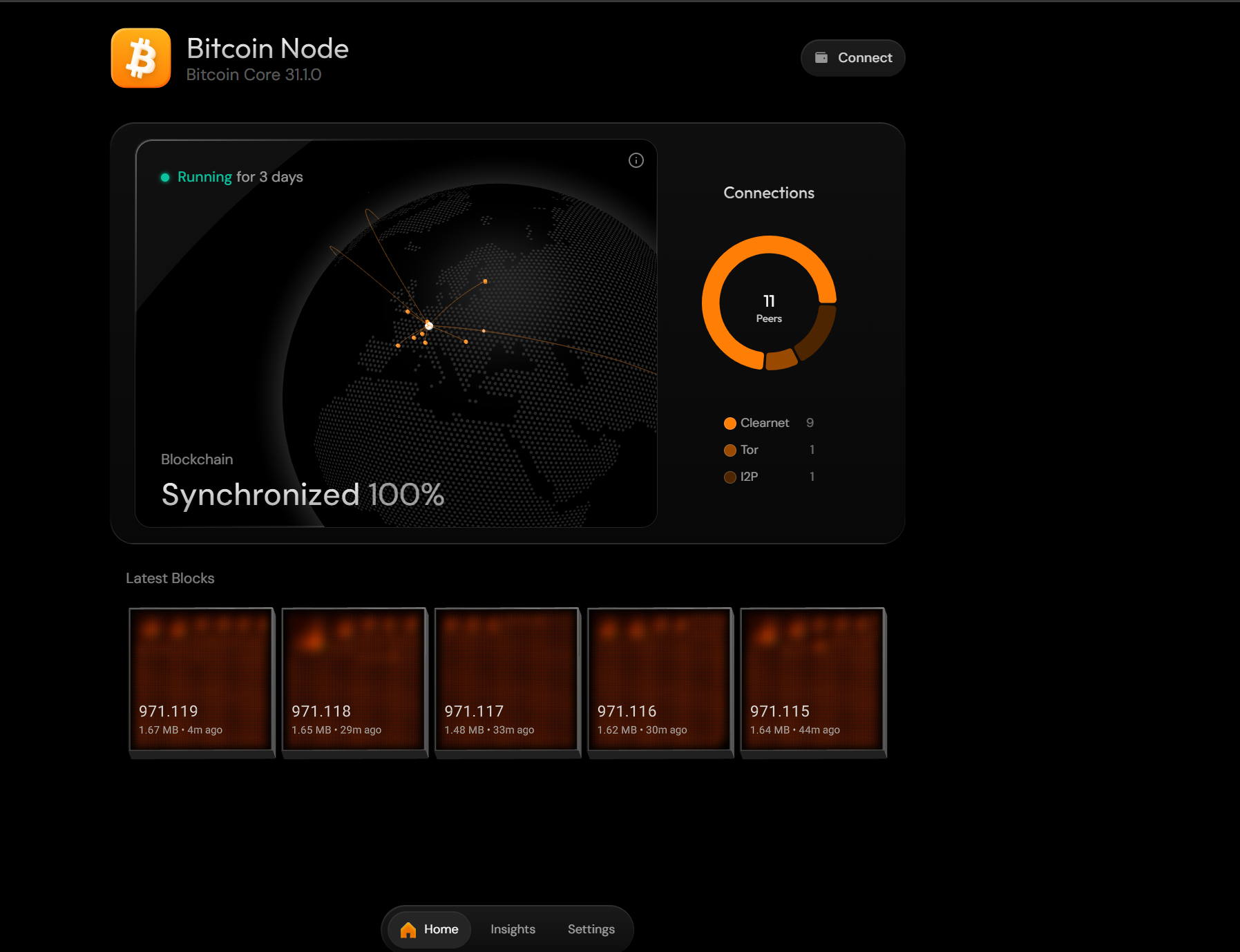
My current screenshot shows Bitcoin Core 31.1.0, 100 percent synchronisation, three days of uptime and eleven peers: nine over clearnet, one over Tor and one over I2P.
It is an unremarkable snapshot. It proves neither perfect job latency nor flawless block submission, but it also shows no obvious synchronisation backlog. I no longer remember the exact Core version running when the May result happened. That does not give us a precise before-and-after comparison. Even the tinfoil hat has to work with the evidence available.
450 G and the sheer cheek of statistics
Here, “450 G” means 450 billion difficulty units, not a hashrate of 450 GH/s. The approximate average wait for a result at least that high is:
| Actual hashrate sustained continuously | Average wait for at least 450 G |
|---|---|
| 20 TH/s | 3.06 years |
| 30 TH/s | 2.04 years |
| 40 TH/s | 1.53 years |
| 50 TH/s | 1.22 years |
Our calculation: difficulty times 2 to the power of 32, divided by hashrate. These figures use 450 G as the threshold; my old record was higher. They are statistical averages, not delivery dates. [1]
At a continuous 30 TH/s, the probability of going 150 days without another result of at least 450 G would be about 82 percent. Five months without an encore would be fairly ordinary in this example.
These are comparison scenarios for the total hashrate being considered. Satoshi-01 does not retroactively inherit the output of every other miner. Its personal record must be compared with its own actual hashrate; if that is lower, the average wait is correspondingly longer.
And here is the particularly mean bit: an early lucky hit does not open a loyalty account with the universe. Randomness owes me no second 450 G result, even if I am now personally disappointed and have given the fans affectionate names.
Rising network difficulty makes finding an actual block harder. It does not change the chance per hash of reaching the fixed comparison threshold of 450 G. The record counter is not a payout progress bar.
Plebs are still allowed to dream
My provisional conclusion is therefore: it looks as though everything is probably fine. We found no indication that the Core versions we examined deliberately disadvantage small lottery miners. This is not a fully measured seal of approval for my setup. That would require suitable operating data.
After this examination, downgrading purely because of lower best-difficulty readings does not seem sensible to me. If something really looks wrong, we will inspect logs, job changes, hashrate, outages and pool compatibility. Until then, the foil stays in the kitchen. Officially, at least.
Satoshi-01 can keep working. The mining warehouses can keep humming. And we plebs can keep hoping that one day a very small fan will bring very big news.
Sources & further reading
The next round of this little series is due in two weeks. Perhaps with new facts. Perhaps with another lesson in patience. Naturally, the secret Department for Very Small Miner Affairs will be investigated again. Until then: keep the coffee warm, keep the node updated and reboot the imaginary conspiracy occasionally.
Aren’t we all a little paranoid?