
#002
A small ode to home Bitcoin mining
Aloha everyone! Home Bitcoin mining is a strange mix of technology, madness, collecting, tinkering, open source and that familiar thought: “Just one more small project, and then I’m done.”
A whale in a garden pond
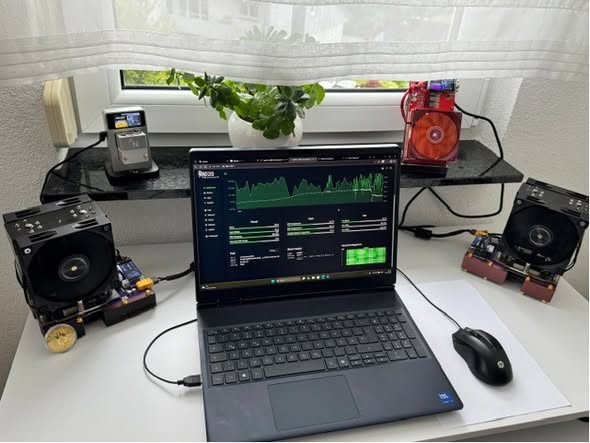
About eight months before my original post, I started with small NM Miners, simply because I did not know any better. Those tiny devices hashed at around 1 MH/s. From a rational perspective, that contributes an extremely small amount of work to Bitcoin mining. Finding a block with one feels like trying to catch a whale in a garden pond with a fishing net.
But for many of us, home mining is not only about profitability. It is cool. It is nerdy. It is open source. It is about learning, testing, measuring and understanding. And yes, sooner or later it also turns into a collecting hobby.
The rational miner and the one that makes you smile
At the time of the original post, if someone had asked me for a sensible starting point, I would have suggested looking at something like an Avalon Q and comparing the money spent per TH/s. That was my personal assessment then, rather than a current buying guide or a calculation of profitability.
Let’s be honest: sometimes you do not want only the most rational device. You want something cool on your desk. Something with a display. Something that blinks, works, shows data and simply makes you smile.
That was why I was looking closely at the Bitaxe Touch by SoloSatoshi. Not because it offered the most raw TH/s, but because it looked incredibly cool and had exactly the nerd factor I love. In the original post, I was considering it as my next miner. That was a plan, not a claim that I had already bought or tested it.
Fishing with electricity and SHA-256
The odds in solo mining are tiny. You know that realistically. But you can also see your setup running, working and participating. In theory, even a small miner can find a valid block. That possibility is not a promise of a reward, and it does not turn the electricity bill into an investment strategy.
For me, home mining is a bit like fishing, only with electricity, SHA-256 and much more blinking hardware. The Bitcoin lottery is part of the fascination, but the hobby has value even when no block appears.
You do not just buy a device
This is what I love about home mining and open source. You learn how a device works. You measure. You optimise. You flash firmware. You improve things. You build something of your own. A former mini miner can even become a useful display for your whole setup – the dashboard project gets its own article here.
You do not always need perfect programming skills. Curiosity, patience, Google, ChatGPT, VS Code and a willingness to stare at error messages for a while can take you surprisingly far.
Does it make economic sense?
Yes and no. Or, more honestly, mostly no. If you think only in TH/s per euro, you will quickly look at other devices. If you enjoy technology, tinkering, open source, small displays, ESP32 boards, Umbrel, Bassin, Bitaxe and NerdQaxe, you understand why these projects can still make sense. Maybe not financially – but technically, emotionally and as part of nerd culture? Absolutely.
Aloha and happy hashing! Maybe one day one of us small home miners will find the golden block. And if not, at least we had plenty of fun building, testing and learning along the way.