
RASTAHASH / REVIEWS · BITAXE GAMMA
Bitaxe Gamma v601: cool copper, lively fans
A chunky copper cooler, a little Bitcoin engine and fans with plenty to say. My 48-hour SuperSink OC test found a steady groove around 1.7 TH/s — after giving the settings a little less espresso. Good cooling, honest watts and a few rough edges.
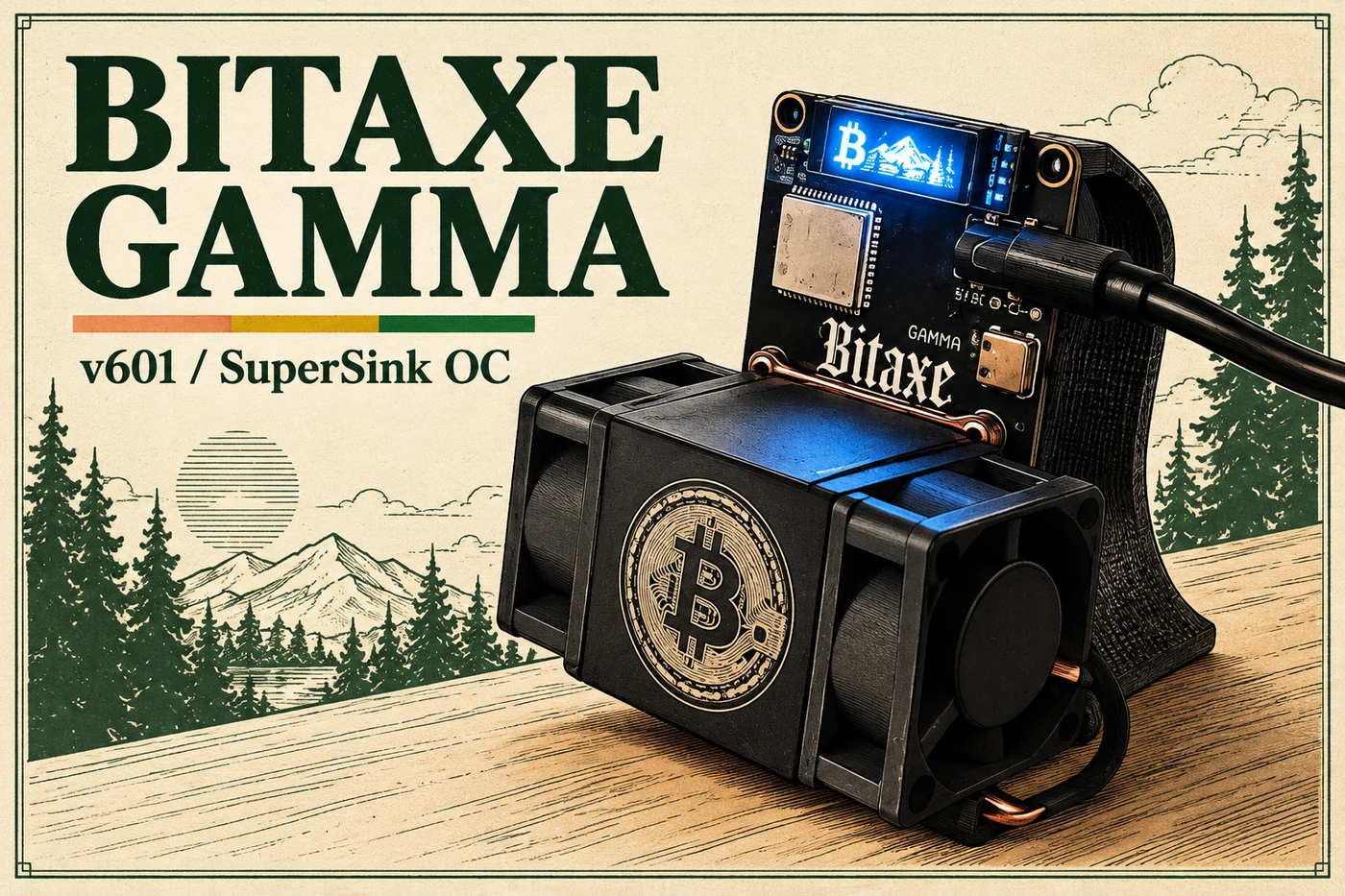
This personal retrospective documents my test on 26–28 January 2026. It ran AxeOS 2.12.2 and firmware 2.12.2 at the time; these are the test versions, not a claim about today’s software. Published in the journal on 7 October 2026.
The little miner at a glance
| Test period | 26–28 January 2026 · 48 hours |
|---|---|
| Device | Bitaxe Gamma v601 · SuperSink Overclocker Edition |
| My sustained operation | 825 MHz / 1.165 V |
| Hashrate reported across the 48h test | about 1.66–1.70 TH/s |
| Power reported by AxeOS | about 34 W |
| Average efficiency | about 20–21 J/TH |
| Stale shares | about 0.05% |
| Hashrate advertised at the time | 1.9 TH/s · not reached in my test |
| Included power supply | 5.2 V / 8 A · 41.6 W rated output |
The Gamma platform uses the BM1370, so this is a different generation from the BM1373 newcomers in my recent roundup. Background on the open hardware project: official Bitaxe Gamma repository ↗. SuperSink and the extra cooling describe the configuration of my particular unit.
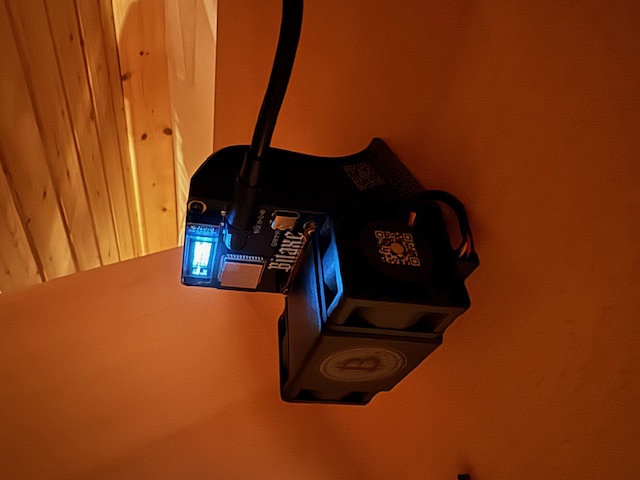
Delivery is good. A complete delivery is better.
I ordered on 16 January, when the unit was listed as in stock. The parcel arrived on 23 January: well packed, with an uncomplicated ordering process. The German mains adapter was missing, though. After I contacted support, it arrived on 26 January, ten days after the order. Not a disaster, but the little hash contender spent a few days on the bench. This describes my delivery experience, not a general verdict on a retailer.
Copper muscles — with a little front-heavy balance
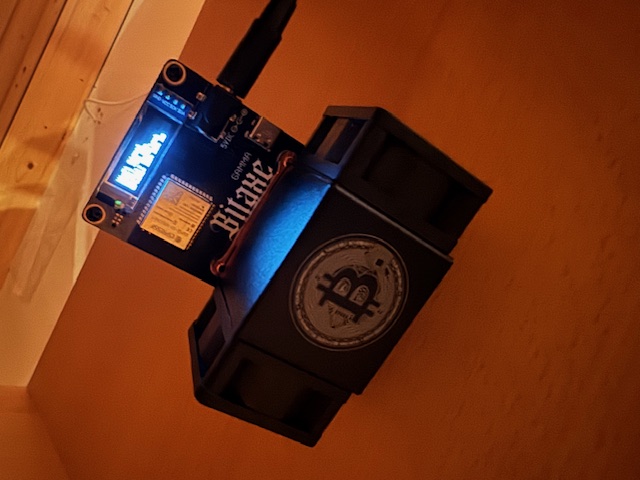
The hefty SuperSink copper block, two GELID fans in a push-pull arrangement and extra voltage-regulator cooling make a solid impression. I like the finish and cast-aluminium frame. The cooling assembly puts plenty of weight at the front, though: in my setup, the unit could tip forwards without the power lead routed behind it. The cable acted as a counterweight. Secure placement matters here; a power cable should not have to audition as a stand.
A little less espresso for the chip
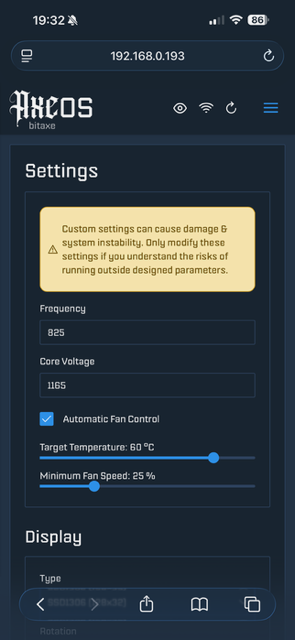
My unit arrived set to 925 MHz and 1.200 V. AxeOS reported approximately 40 W, and the included supply felt very hot. Its 41.6 W rated output sits numerically close to that figure. This does not establish a defect, and I did not measure the supply temperature, but I wanted more breathing room for everyday use.
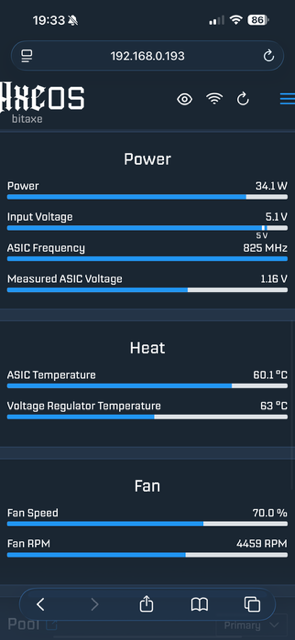
I reduced the settings to 825 MHz and 1.165 V. AxeOS then showed around 34 W, and the miner ran steadily during the 48-hour test. These are device-reported figures, not separately measured wall-power readings. The settings document my test rather than a universal preset for every Gamma. A correctly specified supply with more headroom would be interesting for a future test, retaining the correct voltage and connector. I did not benchmark a replacement supply here.
48 hours in a steady hash groove
Across the test I recorded roughly 1.66–1.70 TH/s, averaging around 20–21 J/TH. The stale rate was approximately 0.05%. The dashboard shown below reads 1.64 TH/s at that instant and 1.68 TH/s over one hour; its efficiency reads 21.91 J/TH instantaneously and 20.39 J/TH on average. That fits the wider observation: a screenshot is one beat; the 48-hour report is the longer playlist.
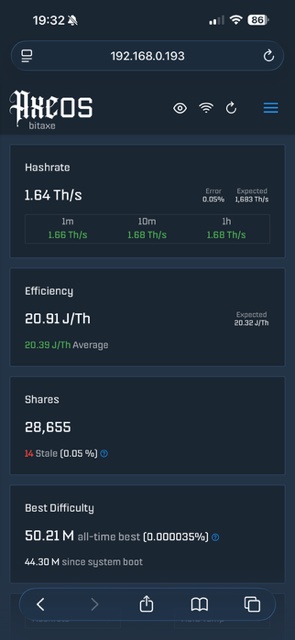
I did not reach the 1.9 TH/s advertised at the time with my reduced operating point. This alone does not prove that the supply caused the entire difference. 1.8–1.9 TH/s with a different supply remains an unconfirmed expectation, not a result of this test. The desk delivered about 1.7 TH/s; anything beyond that needs its own experiment.
The chip stays cool. My ears stay awake.
The cooling works well, but the fans are clearly audible to me. My notes record approximately 41 dB; without a documented distance and standardised measurement method, that is an indicative reading from my setup, not a laboratory comparison. I found the sound distracting even a few metres away in an open landing/sleeping area. Good hashes are welcome; a miniature wind tunnel beside the pillow is a tougher sell.
What stays with me?
Good vibes
- Substantial cooling, extra regulator cooling and a tidy finish.
- Steady 48-hour operation at my reduced settings.
- Around 1.7 TH/s at approximately 34 W reported by AxeOS; roughly 20–21 J/TH on average.
The scratchy notes
- The supplied power adapter felt very hot at the delivered operating point.
- The fan noise is a poor match for my sleeping area.
- The missing adapter delayed the test, and the front-heavy balance needs attention.
My verdict: light and shade, with plenty of tinkering enjoyment. After adjustment, this Gamma ran reliably during the observed test. I like the cooling; supply headroom, noise and balance could feel more comfortable in everyday use. An interesting little miner with character — the coffee still goes to me, while the chip gets a little less voltage. Hash. Learn. Repeat.